Finding Artie
The story of the real people behind The Musician's Promise Series.
THE MUSICIAN'S PROMISE
Rachel Le Mesurier
1/31/20269 min read
My grandad was always fascinated by stories from the past. His favourite stories of all were those of our family's ancestors, and he loved nothing more than going through old letters and records from all over the world, piecing together the shreds of history until he found a new story to learn about.
And boy, did he have some stories in his collection.
Pirates. Privateers. Royalty. Revolutionaries. War heroes. Runaway brides. Actors. Explorers. Even a lord mayor of London or two (as you do).
Grandad led an incredible life of his own, too. A traveller and a musician in his younger days, he survived revolutions, wars, assassination attempts and more. Once, he was ambushed and held prisoner at gunpoint by a man who was convinced he was a spy (he apparently laughed and told the gunman not to be so silly). Another time, he threw himself through the window of a burning building to rescue his infant son, who was playing in the neighbours' house with their child when soldiers unexpectedly burst in and started shooting. Surrounded by gunfire, my grandad managed to rescue his son (my dad) and get out alive, but he would never speak of what happened to the neighbours' family. I know it wasn't good.
It was Christmas two years ago when Mexico became the topic of conversation. My daughter- then two years old- had recently seen Pixar's Coco, and she was obsessed from first watch. I remember mentioning it to Grandad.
Grandad responded by casually telling me that we had family in Mexico. Or at least we used to. The ones who lived there either died fighting in the Revolution or took their money and escaped across the border into the US.
My interest was piqued. I shouldn't have been surprised, really, with all of the explorers, merchants, military men and pirates in our family tree. My family has always had a talent for turning up in unexpected places.
Grandad had found some very interesting people among them, too. There was one chap called either Paulo or Pablo, depending on how you deciphered the handwriting. Grandad had managed to find the record of his death- he was shot. Executed right at the start of the revolution. It never said what for, or which side he was on.
But I was very interested to find out.
Grandad had a whole library's worth of history books in his collection, and he had read every single one of them from cover to cover. He was like Google in human form, his mind as sharp as ever despite his declining physical health. He promised that next time I visited, we would get the iPad out and show me everything he'd found.
His iPad. I've never known a man in his nineties who was more technology-savvy than my grandad. Of course he had a research database on his iPad. He put my own lack of technological prowess to shame.
The Christmas break flew by. Before I knew it, I was out of time, and my only chance of seeing Grandad again was on the way up to the airport for my flight back to the UK.
This time, Grandad had uncovered a bit of scandal... and a mystery. Paulo / Pablo, the guy who was shot and killed at the start of the Mexican Revolution, magically turned up in the records again... crossing the border into the US, five years after his apparent death. And accompanied by a doña.
Now, this could've been a different guy. We couldn't be 100% sure of his name in the first place thanks to the ambiguous handwriting of the original records. But if it really was the same man... was it possible he'd faked his own death and eloped? Grandad had reason to believe the man was a farmhand or some other sort of manual labourer. How else would a man like that turn up with a noblewoman at the border, unless it was a forbidden love story?
Grandad and I agreed that it was unlikely. It was most probably another family member with a similar first name. That's always the trouble with researching family history- people don't tend to make it to the history books unless they're rich or famous. We'll probably never know who he was or what really happened to him.
Bloody fun to imagine, though.
I couldn't let the idea go. I had been imagining all sorts of things as I perused snippets of old handwritten records on the internet, playing out different scenarios in my mind until those characters were so vivid to me, I had to keep reminding myself that a lot of the information I had about them was still just our speculation.
I joked with Grandad that I would love to write some of these stories down sometime. Write a novel inspired by them, at least, if we couldn't find enough information about them to write their true stories.
I was only half-serious about the idea, but Grandad loved it.
"Do it," he ordered. "And when you're next over here, I want to hear all about what you've got so far. I expect to have the first signed copy when it's finished, too. I'll be your number one fan."
I promised. But it was a promise I was destined to break. The next time I was back on the island, less than a month later, it was for Grandad's funeral.
Standing at the front of that church next to his coffin was surreal, but I think the most overwhelming thing about it all was the number of people who were there. The church was full, with people gathered outside to pay their respects. Some had taken two flights or more to get there. And all of them had stories to tell of my grandad from across the years, of all of the amazing things he had done and the incredible life he had led. It was very emotional.
I started researching as soon as I got home, determined to continue with the inspiration Grandad had given me. I didn't have his books or his beloved iPad (I still haven't seen it even now, he didn't tell anyone the flipping password), but I had the internet and the Priaulx Library, and it was a start.
And so began the arduous task of researching. I won't bore you with the challenges and frustrations of trying to decipher faded, elaborate handwriting from poorly-scanned images of old documents, but if you ever try to research your family history, you will discover the same issues I did: money talks, even across generations.
Any ancestors who were rich, literate and held any sort of political power were easy to trace. There were government records, letters, portraits, photographs- you name it, it was there on the internet waiting patiently for my perusal.
But the people I was looking for this time were not wealthy, powerful or even necessarily literate. Their records were few and far between; the odd birth, marriage or death certificate, sometimes an immigration paper or military record. Spellings of names were at best inconsistent, at worst erratic. All of the documents were handwritten, usually in Spanish and frequently missing important information like dates. Many long nights were spent squinting at the laptop screen, trying to work out whether a letter was an 'a' or a 'd', or whether a number was a '6' or an '8'.
The first thing I confirmed was that Grandad had been right about the dates when our family first arrived in Mexico- our family had already established themselves in the country as merchants before the famed 'second French intervention' of 1862. Louisa Aimee Le Mesurier (or Le Masurier as it was also spelled back then) was born on 17th November 1854 in Mexico City. Her mother was Esther Elizabeta Le Masurier (birthdate unknown), and she was also from Mexico City.
Interesting fact: The name 'Louisa', being the first name I had found in my research, stuck. Louisa became Esperanza's social-climbing mother in the books. I kept the European spelling rather than changing it to the more Mexican 'Luisa', to reflect the character Louisa's half-European half-Mexican ancestry.
Then I found Maria... and that's when things really started to get interesting.
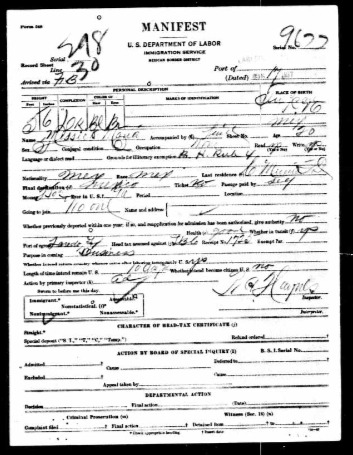
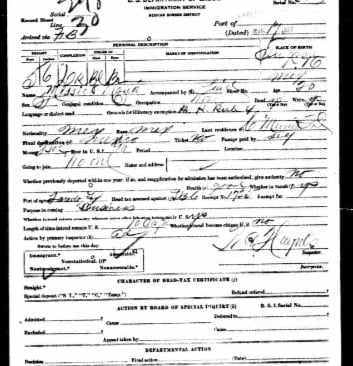
Maria Le Mesurier. Born around 1896 in Tuxpan, Veracruz, Mexico. Crossed the border into the US from Mexico on 17th June 1916, at which point it was noted that...
She was 20 years old.
Identified as Mexican.
She was 5ft 4inches tall, with black hair and blue eyes, and was reported to be in good health at the time of travel.
She was not literate.
She gave her last address as Le Mesurier Villa, indicating that she must have been from a wealthy family.
She was traveling with someone, and claimed that she was crossing the border for business reasons and she planned to return to Mexico.
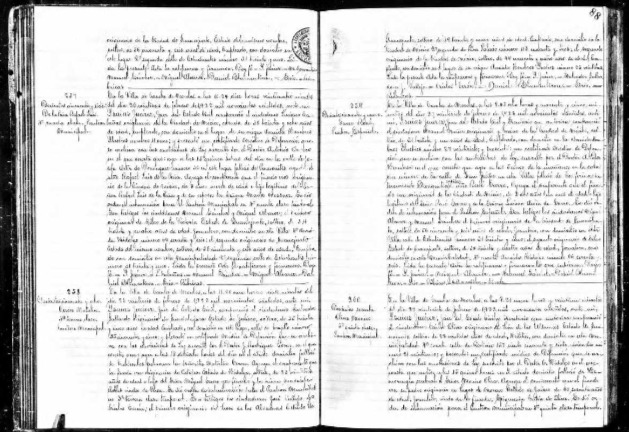
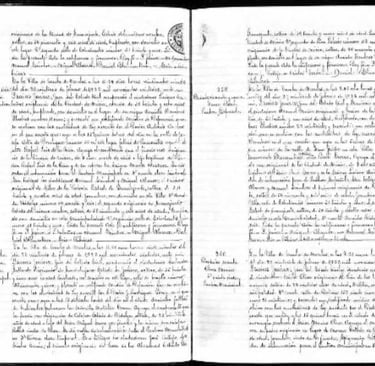
In 1922, Maria's name appears again, this time in the Civil Registration Deaths records in Federal District, Mexico.
It is not her death recorded, but that of her husband, Rafael Luis de la Peña. It is also recorded that the couple had a son, also called Rafael.
Maria played on my mind.
Perhaps it was the knowledge that she had a few things in common with me, with her dark hair and blue eyes, but I formed an image in my head of how she might have looked and what her personality might have been like. In my mind, she was beautiful, brave and fiery. I must admit, Catherine Zeta-Jones' character in 'The Mask of Zorro' contributed a lot to my imagination too, as did the character of Imelda from Pixar's Coco, which I was being forced to watch about six times a day by my daughter at that time. (Note: I say forced. I loved every minute of it.)
I had done a lot of research about the Mexican Revolution by that time, and knew that the middle classes were in a strange limbo at this point in history, not suffering the hardships of the poor but at the same time unable to break into the upper classes of society. Eventually, the image I had in my mind of my heroine became Esperanza. While I liked the name Maria, I thought that the name 'Esperanza' suited my character better. Esperanza means 'hope', which is one of the mantras for the revolution.
And in The Mask of Zorro, she was also the wife of Diego de la Vega, and mother to Catherine Zeta Jones' character Elena, which may have helped me to fall in love with the name.
Then came creating Arturo's character.
I had already decided that the hero of my novel was going to be a musician (in tribute to my Grandad), and that his name would be Arturo (courage, another mantra for the revolution). Only later did I discover by complete co-incidence that there was actually an Arturo Le Mesurier / Le Masurier, although he died aged 23 in 1902 (8 years before the revolution officially started).
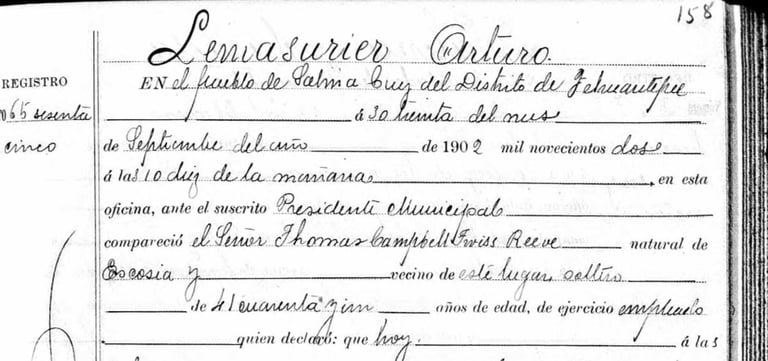
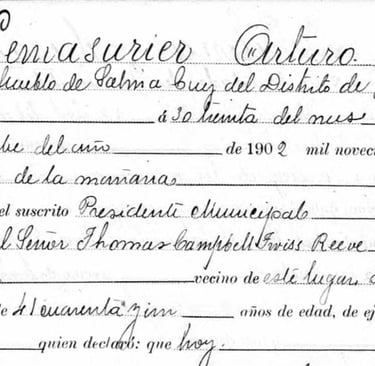
He appears to have been a close relative of the same Paulo / Pablo my grandad told me about, although finding any official documentation confirming this has been difficult. He died young with no known wife or children, and we know that he died of a gunshot wound.
Inspiration for other characters also came from the snippets of information I managed to find in the records.
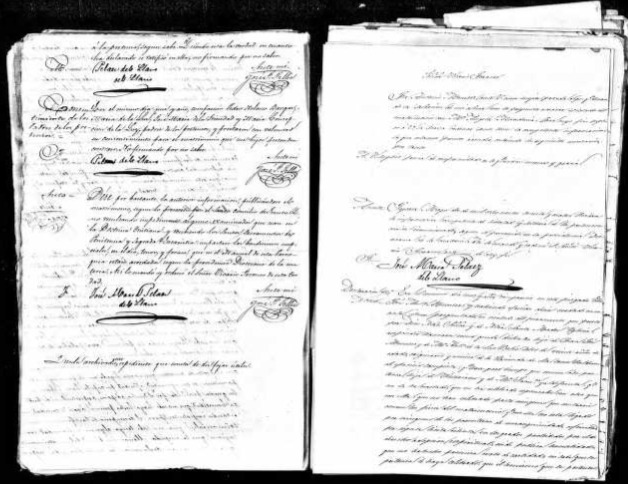
Catholic church records for José Antonio Le Mesurier.
These records confirm that José was engaged to MA. Angela on 2nd May 1864, aged 20. This puts his year of birth at 1844. The engagement took place in San Francisco, Tepeaca, México (Mexico). The records also note the name of his father, Juan José Le Mesurier, and his mother, MA. Anta De La Luz Beter.
Juan became the name of Esperanza's father as a result.
There are many more examples like this, where personal historical records and information taken from a variety of history books and documentaries combined to form the fictional characters in 'The Musician's Promise'. These real people may have inspired fictional characters, but what happens to them in the novels is based on stories my grandad told me of his own adventures, as well as other friends and family members from the past.
Which bits? I can't tell you- you'll have to read the books to find out! Spoilers, darlings!